Safety
4-point harness and roll cage: why they matter on a UTV
What a ROPS roll cage does, how a 4-point harness differs from a lap belt, and how to fit one properly before a UTV or dune buggy tour in Huacachina.
Published on 7 October 2026 · 7 min read
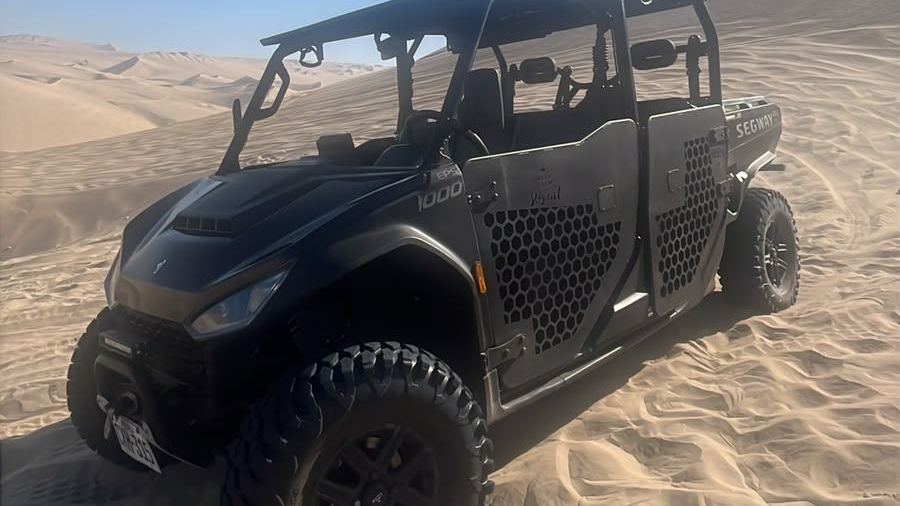
A 4-point harness and a roll cage matter because they work as a pair: the ROPS cage keeps a clear space around the occupants if the vehicle rolls, and the harness keeps you inside that space. A cage without proper restraint protects an empty gap; a harness without a cage straps you firmly into a vehicle with no strong roof. The helmet covers what's left, which is your head against the structure.
That's the core of it. The rest is for anyone who wants to understand the equipment before getting into a UTV in Huacachina, or who is comparing dune buggy tours and wants to know what to look at beyond the listing photo.
If you're after the general comparison between a UTV and a classic sand buggy, we already wrote it: UTV or sand buggy: what actually changes for your safety. This one goes piece by piece, and above all into something almost nobody explains: how to fit a harness properly.
What a ROPS roll cage is and what it actually does
ROPS stands for Roll-Over Protective Structure. On the UTVs we use it comes from the factory: the manufacturer designs it together with the rest of the chassis and tests it. Nobody welds a tube on top afterwards.
Its job starts once the rollover has happened: if the vehicle tips over on a dune, the roof doesn't collapse onto the people inside, and there's still a space where seated occupants fit. Some people call it the "survival zone", and the picture works.
Now the part that matters: the cage protects what's inside it. An arm out the side, a hand wrapped round the outer tube, a head poking out to film on a phone. All of that sits outside the protected zone. That's why the US Consumer Product Safety Commission, in its guidance for side-by-side off-road vehicles, stresses always fastening seat belts and keeping every part of your body inside the vehicle.
A habit we see a lot: the passenger riding with a hand resting on the door tube, on the outside, "because it's comfier". Hold on from the inside, always.
4-point harness vs 2-point lap belt
A 2-point belt crosses only your hips. It keeps you in the seat, but your upper body is free to fold forwards or sideways. On a road, sudden movement is mostly forwards; on a dune you also get vertical and sideways jolts, and a loose torso moves exactly when you most want it to stay put.
A 4-point harness has two hip straps and two shoulder straps that meet at a central buckle. Your body is held at the pelvis and both shoulders at once, pressed against the seatback. You feel it straight away. On a descent your body doesn't float off the seat and your head doesn't swing around.
The World Health Organization notes that in road crashes wearing a seat belt reduces the risk of death among vehicle occupants by up to 50%. That figure comes from roads, not dunes, but the idea carries over: restraint is what protects the people inside.
How to fit a 4-point harness properly
A good harness worn badly does a lot less. This is the order worth following (and what we look at when we check harnesses person by person):
- Sit all the way back. Back and hips against the bucket seat. If you perch on the edge, everything else ends up wrong.
- Hips first. Straps low, across the hip bones, not across your stomach. Snug.
- Then the shoulders. Straps run over the collarbone, not rubbing your neck and not sliding off towards your arm. Flat, no twists.
- Buckle in the middle. It should close with a clear click. Tug it to check.
- Slack test. A good rule of thumb: a flat hand fits between strap and chest, and not much more. If you can lean forward freely, it's loose.
- Nothing under the straps. No phone in a chest pocket, no bum bag, no bunched-up hood.
The most common problem is a shorter adult, or a child, whose shoulder strap crosses the neck. No amount of adjusting fixes that: either the seat is too big for them or they need to sit somewhere else. The same CPSC guidance gives an easy test: don't carry a passenger who can't put both feet on the floor with their back against the seat. So if you're travelling to Huacachina with kids, tell us ages and heights in advance; we look at each case on its own.
Then there's the grown-up classic: loosening the shoulder straps halfway through because they "feel tight". They feel tight because they're right. If they genuinely hurt, stop and readjust. What you don't do is ride on with the harness hanging off you.
Bucket seats, side nets and helmets: the rest of the system
The bucket seat has side bolsters that hold your torso and hips. It looks like a comfort feature, but it's what lets the harness do its job: if your body slides sideways on a flat bench, the straps are no longer where they should be.
Side nets close the door opening. Their job is half psychological, because they stop the reflex of shooting an arm out to grab something when the vehicle leans. Everyone has that reflex, calm people included.
The helmet covers what the harness and cage can't: your head, which even strapped in stays close to the frame tubes. Everyone gets one, driver and passengers. To be any use it has to sit firmly: shake your head side to side, and if the helmet lags behind, it's too big. The chin strap stays fastened at all times, including photo stops, which is exactly when people undo it and then forget to close it again.
The same WHO fact sheet says that, for motorcyclists, correct helmet use reduces the risk of death in a crash by more than six times. Again, road data, and from motorbikes. But it explains why we make no exceptions for passengers.
What the equipment won't do for you
No harness makes up for a windy day, a show-off pace or a route nobody checked. Equipment is the foundation, and protocol goes on top: a vehicle check before leaving (brakes, tyres, harnesses, fuel, radio), a briefing, a practice run on flat ground, a guide in front marking the route, radios between vehicles, and rescheduling if visibility is poor. It's all on our safety page.
If you're comparing operators, the useful move is to ask about each piece: is the cage factory-built, how many points does the restraint have, are there helmets for everyone? 6 signs a Huacachina dune tour is not safe covers what you can check with your own eyes on the day. In fairness, many classic buggies are well built and well maintained. Where they differ is that their frame depends on the workshop that welded it rather than on a factory test.
To book a UTV tour on the Huacachina dunes, message us on WhatsApp at +51 967 564 701 with your date, how many of you there are, ages (and heights if kids are coming), your hotel and whether anyone would rather ride as a passenger than drive.
Frequently asked questions
What does ROPS mean on a UTV? It stands for Roll-Over Protective Structure, the frame that protects occupants if the vehicle rolls. On a factory UTV it's designed and tested by the manufacturer itself.
Is a 4-point harness safer than a normal seat belt? On dune terrain it holds you better, because it secures your shoulders as well as your hips and your upper body stays put through sideways and vertical jolts. It only works if it's fitted properly, though.
Can children use a 4-point harness in a UTV? It depends on their size: the shoulder strap mustn't cross the neck and they need to sit with feet down and back against the seat. Message us with ages and heights and we'll tell you what's possible for your family.