Safety
Driving a UTV on sand: what the briefing covers
What you learn before driving a UTV on sand in Huacachina: controls, flat-ground practice, going up and down dunes, the crest rule, spacing and radio.
Published on 7 October 2026 · 7 min read
The briefing before driving a UTV on sand covers five things: the controls (throttle, brake, steering and gear selector), a practice run on flat ground, how to go up and down a dune, why you never brake or stop on the crest, and how to follow the guide (spacing, attention and radio). Once that's clear, the rest of the ride is following a line that somebody has already checked.
You don't need off-road experience. Plenty of people who drive with us in Huacachina had never been in a UTV before, and some don't even drive at home. What you do need is to actually listen to the briefing, phone away, without the "yeah, yeah, got it" of someone already staring at the big dune behind us.
Here's what gets explained and, more importantly, why, so you turn up knowing what to expect from your Huacachina dune buggy tour.
What the briefing covers before driving a UTV on sand
Before the briefing there's a part you don't see: the vehicle check (brakes, tyres, harnesses, fuel and radio). Then comes your part, and it starts with your body, not the engine. Helmet, harness and footwear are checked person by person. Whoever arrives in flip-flops, and someone always does, learns here that the brake pedal is unforgiving and that the sand gets properly hot by late morning.
At the Imperial Sand Dunes in California, the land agency requires a helmet for driver and passengers and a belt or harness fastened whenever the vehicle is moving, according to its published rules. There's no rule like that posted out on the Huacachina sand, but we work to the same standard. If you want to know how a well-fitted harness should sit, we explain it in 4-point harness and roll cage: why they matter.
The controls
The guide walks you round the vehicle hands-on: throttle, brake, steering wheel and gear selector. What surprises people used to driving a car in a city is how sand responds.
Throttle goes on smooth and progressive, because a stab of it makes the wheels dig instead of moving you forward. The second surprise is that sand brakes for you: the moment you lift off, the vehicle slows far quicker than on tarmac. That's why you rarely need a hard stop, and a hard stop on a descent is exactly what you don't want.
Steering? Calm. Sharp turns in soft sand unsettle the vehicle more than you'd expect, and more than one keen racing-game player has found that out on the first bend.
The flat-ground practice run
Before you see a single dune, you drive on flat ground until you're comfortable with throttle and brake. There's no set number of laps: it takes as long as you need. Some people are ready on the second lap, others ask to go again, and both are fine.
This run helps us too. It's where we see who's tense, who's laughing nervously and who's heavy on the throttle, and we adjust the group's pace accordingly. If someone decides they'd rather ride as a passenger, this is the moment, and nobody minds. Lots of groups take turns at the wheel during the trip.
How to drive a UTV up and down a dune
This is the part people come to hear, and the part online videos get most wrong.
Going up. You follow the line the guide sets, with steady throttle. No hesitating halfway: lift off mid-climb and the vehicle loses momentum and bogs down on the slope. If that happens, don't floor it to "get out", because the wheels only dig deeper. Call it on the radio and the guide tells you what to do.
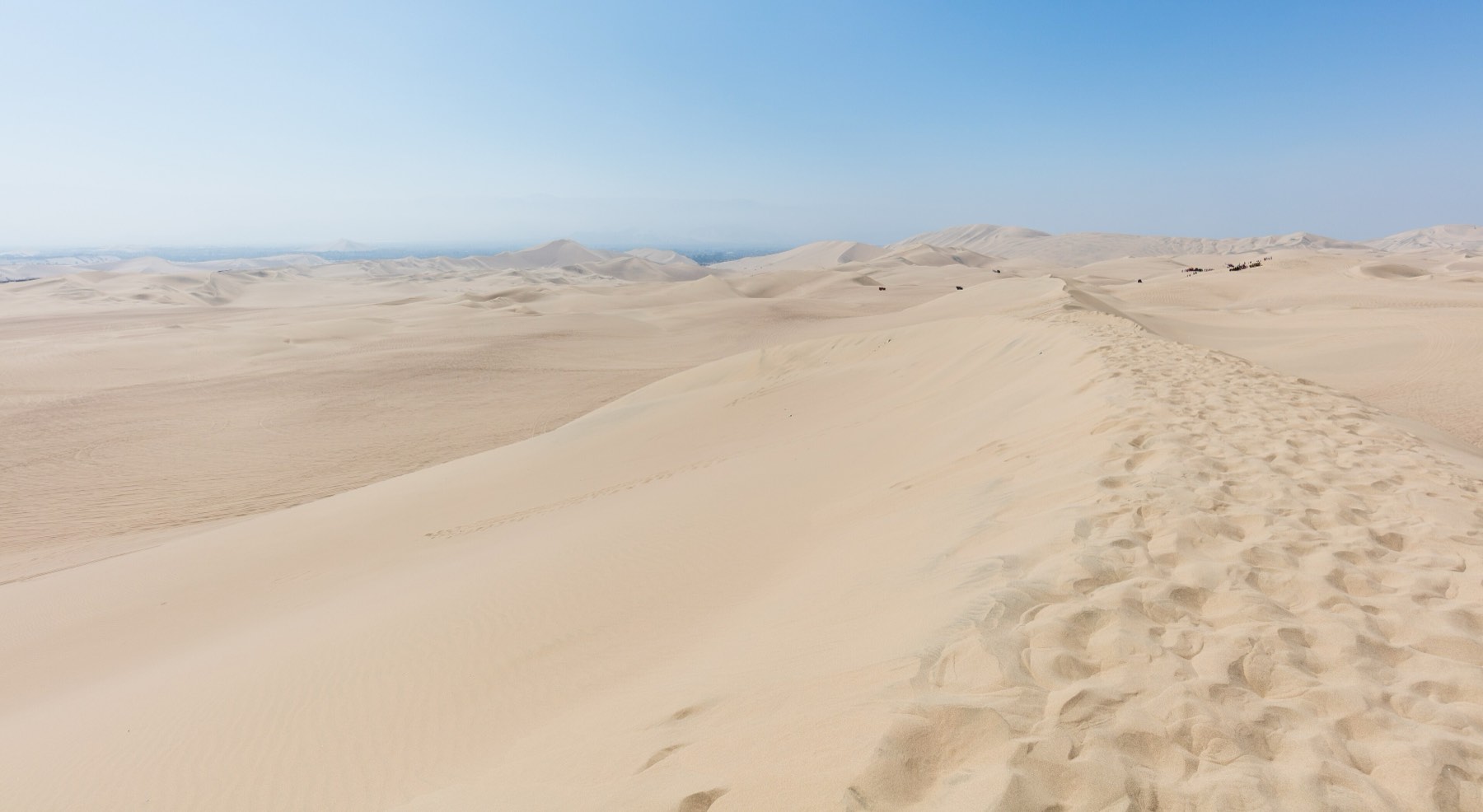
The crest. This is the golden rule on sand: never brake or stop on top of the crest. From up there you can't properly see what's on the other side, and nobody on the other side can see you. The guide knows where it's safe to stop and will show you. Your only job is not to improvise.
Coming down. Straight down, in the guide's tracks, never cutting across the face of the dune at an angle. Light on the pedals, no hard braking and no extra throttle "for fun". The vehicle comes down under its own weight and the sand slows it; your job is to keep the wheel straight and stay calm.
What frightens people is hardly ever the big descent. It's the first crest, when the bonnet points at the sky and for an instant you can't see the ground. That's why it gets explained beforehand.
What we won't teach you: jumps, drifts or sideways descents. They're possible, sure, but they have nothing to do with a guided tour and a lot to do with most of the scares you see on the dunes.
Following the guide: spacing, attention and radio
The guide is out front the whole time. Their vehicle sets the route, and they checked that route before you did.
Spacing. Far enough back to see the ground between you and the vehicle ahead, and to stop if it stops. Tailgating on sand means eating their dust cloud and seeing nothing. In a convoy the opposite mistake happens too: someone drops so far back they lose the line over a crest.
Watch the guide. With a helmet on and the engine running you won't always hear the radio clearly, so keep the lead vehicle in sight: if it brakes, you brake; if it slows, you slow. Sounds obvious. It goes out the window the moment the person next to you starts filming and chatting.
Radio. Every vehicle has one. It lets the guide warn you about what's coming and lets you say "stopping", "I'm stuck" or "someone feels sick". That last one gets used more than you'd think: the friend who swears they're fine and goes pale on the second dune. Speaking up early beats toughing it out.
The lead vehicle also carries a first-aid kit, water and GPS. And if the wind starts lifting sand and visibility drops, the plan changes. Peru's weather service, SENAMHI, posts weather warnings when it expects strong wind on the southern coast, and on those days we reschedule, no argument.
One more, obvious as it sounds: no alcohol before you drive (the Imperial rules mentioned above ban it while riding). The US Consumer Product Safety Commission's guidance for this kind of vehicle also sums up what we repeat at every briefing: belt fastened and every part of your body inside the vehicle. Save the pisco sour for the evening.
Our whole protocol is summed up on the safety page. If you're comparing operators, 7 questions to ask before booking a Huacachina dune tour tells you what to ask about anyone's briefing.
To book your UTV tour in Huacachina, message us on WhatsApp at +51 967 564 701 with your date, how many of you there are, ages, your hotel, who wants to drive and who'd rather ride as a passenger. If someone has never driven or is nervous, tell us: we factor it in from the flat-ground practice onwards.
Frequently asked questions
Is it hard to drive a UTV on sand? Not if you follow the guide. The new part is how sand responds: gentle throttle, hardly any braking and calm steering, and you pick that up during the flat-ground practice.
Do I need experience to drive a dune buggy in Huacachina? No off-road experience is needed. We explain the controls, you practise on flat ground and you follow the guide on a marked route; if you prefer, you ride as a passenger.
What happens if I get stuck on a dune? Don't floor it, because the wheels will only bury themselves deeper. Call it on the radio and the guide will tell you how to get out or come and help.