Safety
Can I drive a UTV in Huacachina? Rules and requirements
Can I drive a UTV in Huacachina? Yes. No professional licence needed; minimum age and zero alcohol, the flat-ground practice run, and what if you get nervous.
Published on 7 October 2026 · 7 min read
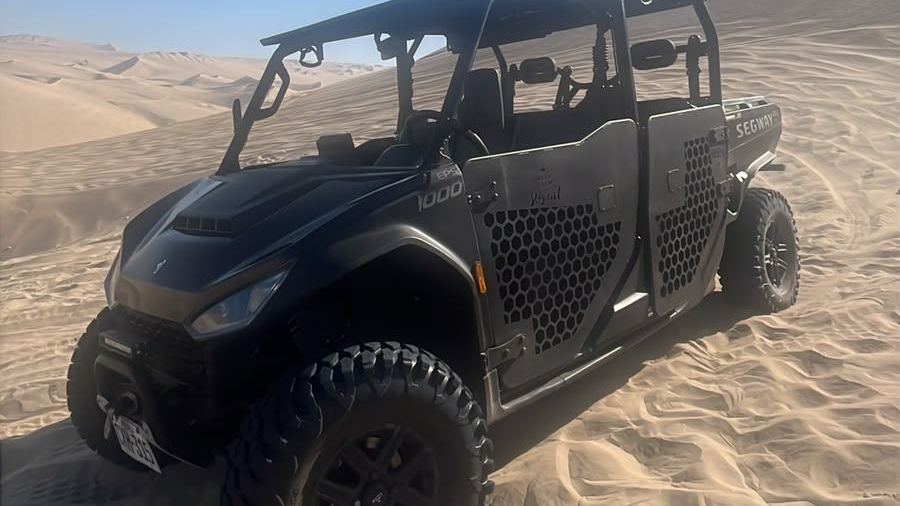
Yes, on our Huacachina tour you drive the UTV yourself. You're not a passenger behind a hired driver: you're at the wheel, with a guide in front marking the route and radios between vehicles. For the guided experience no professional licence is required, but the driver does need to meet our minimum age and be fit to drive. We confirm the exact age and anything else that applies to you over WhatsApp, rather than guessing in a blog post.
It's the question we get most, and it usually comes with a worry attached: "but will I manage?" People who barely drive at home, people who've never touched an off-road vehicle, people who've only ever seen the dunes from the bench of a sand buggy. We've spent more than 12 years in the Ica desert, and the most common situation by far is exactly that: never having driven anything like it.
Can I drive a UTV in Huacachina if I've never done it before?
Yes. The whole setup is designed for beginners.
Our UTVs are factory-built side-by-sides, and the guide walks you through every control in the briefing before you touch any of them. What really changes is the ground. Sand doesn't behave like tarmac. It brakes differently, it pushes back differently, climbs need commitment and descents need patience. That's what you practise before heading out.
What decides how much you enjoy it isn't experience. It's going at your own pace, on a marked route, following the guide, who goes ahead on every stretch. That's why driving yourself doesn't make the tour less safe: you pick the speed, within the pace and route the guide sets. Nobody's going to ask you to go faster than you want to.
If you're weighing this up against a classic Huacachina dune buggy tour where a driver takes you, we compare the two point by point in UTV or sand buggy: what changes for your safety.
Requirements to drive: age, licence and being fit to drive
Here's what we know, and what we won't put in writing as a blanket rule.
Licence. No professional licence is required for the guided experience. If you have a specific question (a foreign licence, an international permit, an expired one, one you only just got), message us and we'll answer for your case.
Minimum age. There's a minimum age to drive. We don't publish it as a general number because it can depend on the vehicle and the situation, so send us everyone's ages and we'll tell you who can take the wheel and who rides along. Travelling as a family? Read our post on a UTV tour with kids too.
Being fit to drive. This is the one people forget, and it matters most. It means:
- Zero alcohol. Not a beer with lunch, not "one pisco sour for the nerves". The World Health Organization notes that on the road, crash risk starts at low blood alcohol levels. If you've been drinking, you don't drive. A heavy hangover from the night before counts too: if the guide thinks you're not fit, you ride along.
- Nothing that makes you drowsy. Some medicines (antihistamines, motion-sickness tablets, muscle relaxants) slow your reactions. If you're taking something, check with your doctor and tell us.
- Good eyesight. If you wear glasses to drive, bring them, ideally with a strap.
- Closed shoes. You can't brake properly barefoot or in flip-flops. Every year somebody shows up in sandals.
If you have a physical condition you're unsure about (back, heart, pregnancy), check with your doctor and let us know in advance. Then we can tell you what's possible in your case.
What the flat-ground practice run is like
Before you see a single dune, this happens, in this order:
- We check the vehicle: brakes, tyres, harnesses, fuel, radio.
- Safety briefing and a walk-through of the controls. Where everything is, what it does, and how we communicate on the route.
- We put your helmet on and fit the 4-point harness, which holds both shoulders and hips, person by person. We check footwear too.
- Practice on flat ground. You pull away, accelerate gently, brake, turn. Then again. The guide watches how you're getting on.
There's no fixed number of laps. The practice run goes on as long as you need it, and it ends when you're comfortable with throttle and brake, not when the guide gets bored.
What we typically see: the person who stamps on the throttle like they're late for a flight and gets a fright from the jolt; the one who brakes so hard the rest of the group cracks up; the one who's completely relaxed by the third lap. All normal. That's what the flat ground is for.
If you'd like to arrive knowing what's coming, we have a post on what the briefing covers about driving on sand.
What if I don't feel confident driving?
You hand over the wheel. Simple as that.
Nobody makes you drive at any point. You can do the practice run and decide you'd rather ride along. Or start driving and swap at the first stop. Some people take the gentle stretches and hand over for the ones that look steep. Groups swap drivers all the time, and nobody bats an eye.
And if you want to drive but take it easy, say so. We adapt the pace to the group: the guide in front sets the pace for the convoy, and within that, how hard you press the throttle is up to you. We've had drivers who started tense and finished asking for one more run, and others who happily rode shotgun the whole way taking photos. Neither is wrong. If nerves are what's holding you back, read about doing a UTV tour when you're scared.
One thing we do ask: if you go pale or feel sick on the second dune, tell the guide at the next stop, or sooner if you need to. "I'm fine" from the brave ones is the phrase that worries us most out here.
Taking turns, passengers and the part that's out of your hands
Every UTV has a driver and passengers. Everyone wears a helmet and a harness, not just the driver. Seats are bucket-style with side nets, and the ROPS rollover cage comes from the factory, designed and tested by the manufacturer.
Some things don't depend on how keen you are. If the wind lifts sand or visibility drops, the outing gets rescheduled, no argument. Peru's weather service, SENAMHI, issues warnings about stronger winds on the central and southern coast, and out on the sand you feel it straight away. That's why we suggest not leaving the dunes for the very end of your trip. Everything we check is on our safety page.
To book or check your situation, message us on WhatsApp at +51 967 564 701 with: the date, how many of you there are, everyone's ages, who wants to drive, any doubts about a licence or a health condition, and where you're staying. We'll tell you who can drive and set up your UTV tour.
Frequently asked questions
Do I need a driving licence to drive a UTV in Huacachina? No professional licence is required for the guided experience. You do need to meet our minimum age and be fit to drive; message us and we'll confirm your case.
Can I ride as a passenger instead of driving? Yes. Many groups take turns at the wheel, and some people ride along for the entire tour, wearing the same helmet and harness as the driver.
Is it hard to drive a UTV on sand? It's easier than it looks, and most people have never driven anything like it before. The new part is the terrain, which is what the briefing, the flat-ground practice and the guide up front are for.